

You know what to do.
You know that movement supports your heart, strength, and metabolism. You know that sleep matters. You know that nourishing meals, stress support, and regular healthcare can help you feel more vibrant.
Still, your routine keeps falling apart.
You are not undisciplined. You are facing barriers that were never accounted for.
Find the Barrier That Is Actually Yours
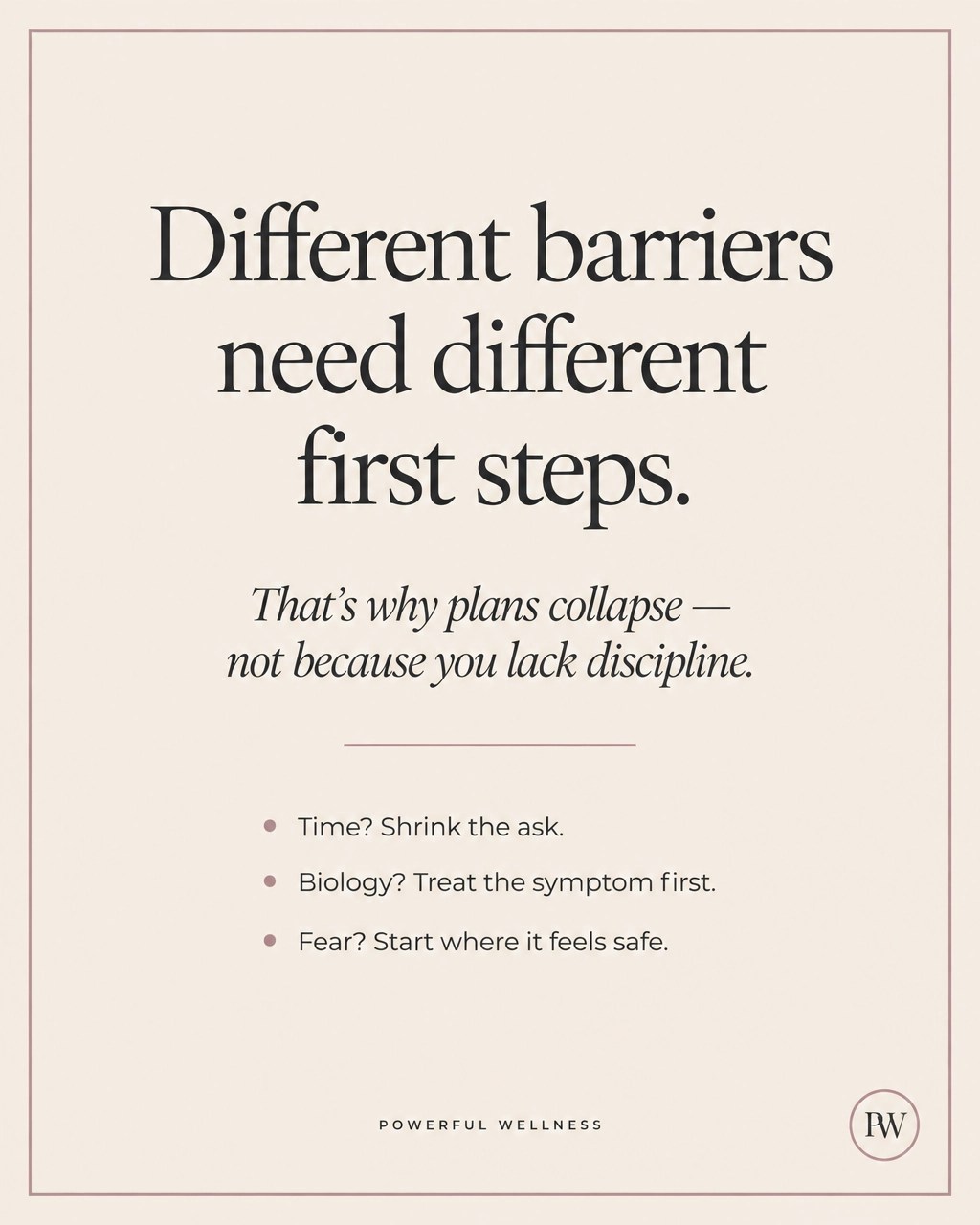
Different barriers require different first steps.
Solve the wrong problem, and your plan may collapse again.
This is the real reason so many health plans fall apart. The issue is often not motivation. It is mismatch. When your plan does not match your biggest barrier, it becomes harder to keep going.
- If time is the barrier, shrink the ask. Start with a 10-minute walk or one movement break instead of planning an hour at the gym.
- If biology is the barrier, address the symptom first. Prioritize sleep support, pain evaluation, or a conversation about perimenopause symptoms.
- If knowledge is the barrier, choose one lever. Focus on a consistent breakfast, daily walking, or one strength session each week.
- If fear is the barrier, create safety. Begin at home, ask for guidance, or choose a supportive group.
- If money is the barrier, remove the expense. Use free community resources and routines that require little or no equipment.
Why These Barriers Are Real
Women over 35 often spend years putting everyone else first. The problem is rarely laziness or a lack of information. The problem is that your plan may not match your time, energy, biology, environment, or current readiness.
Let’s look at why these barriers show up, and why naming the right one can help you move forward with more honesty and less self-criticism.
Your Barriers Are Real
Time and energy debt
Notice how much energy you spend before you ever reach your own needs.
Work. Parenting. Caregiving. Household management. Appointments. Emotional support. Planning meals. Remembering everyone’s schedules.
By the time you reach the end of the day, your “free time” may already be gone. This is time and energy debt: the accumulated cost of carrying responsibilities for other people.
When you are always last in line, a health routine can feel like one more obligation instead of a source of support.
Start by asking, “What can fit into the life I have?” — not, “Why can’t I do what someone else is doing?”
The all-or-nothing trap
Many women believe a routine only counts if it includes a full gym session, a perfect meal plan, or a completely open hour.
That belief creates a fragile system.
Miss the 60-minute workout, and you do nothing. Eat one unplanned meal, and the entire day feels ruined. Sleep poorly, and you decide to restart next Monday.
Replace perfection with participation. Ten minutes of movement still counts. One balanced meal still counts. Going to bed earlier still counts.
Build a routine that can survive an imperfect week.
The knowledge-to-action gap
You may not need more information. You may need help deciding which information applies to you.
Online advice can be conflicting, overly rigid, or designed for someone with a different body, schedule, budget, or health history. One person says to fast. Another says to eat more often. One plan emphasizes cardio. Another insists on strength training.
When every recommendation sounds urgent, choosing nothing can feel safer.
Choose one practical lever at a time. A clear, informed starting point is more valuable than a long list of competing rules.
Shifting biology
Perimenopause can make old routines feel less effective.
Sleep disruption can reduce energy. Hot flashes can interrupt rest. Mood changes can affect motivation. Joint discomfort can make movement feel intimidating. Brain fog can make planning harder.
Metabolic changes may also mean that strategies that worked in your 20s or early 30s no longer produce the same results.
This is not a discipline problem.
Treat symptoms as information. If sleep, mood, pain, or hormonal changes are interfering with daily life, bring them to a qualified healthcare professional. You can also explore the free Perimenopause Essentials guide for foundational information.

Cost and access
Health recommendations often assume unlimited resources.
Gym memberships cost money. Wearables cost money. Specialty foods, lab work, appointments, transportation, and childcare can all add up.
Time poverty and money poverty often happen together. A plan that requires expensive equipment, several appointments, or hours of preparation may not be realistic right now.
Choose accessible options first. Your routine can begin with walking, bodyweight strength exercises, library resources, community programs, free videos, or food already available at home.
Mental load, mood, and burnout
Depression, anxiety, ADHD, grief, and burnout can make habit-building harder.
These experiences can affect focus, motivation, sleep, planning, and the ability to begin a task. They do not mean you are weak or incapable.
Name the emotional barrier without judgment. Then reduce the number of decisions required. Put the walking shoes by the door. Keep a simple breakfast available. Write down one next step instead of holding the entire plan in your mind.
If emotional symptoms feel severe, persistent, or unsafe, seek professional support promptly.
Fear and past failure
Past attempts leave an imprint.
You may fear getting injured, being judged in a gym, disappointing yourself again, or hearing another provider dismiss your concerns. Medical trauma can also make appointments and health changes feel difficult.
Start where you feel safe. Choose a gentle movement option. Ask for clear explanations. Bring questions to your appointment. Work with a qualified professional who listens and respects your goals.
Confidence grows through safe experiences, not through forcing yourself into situations that feel overwhelming.
Environment and social context
Look around your daily environment.
Do you have a safe place to walk? Does your household support your goals? Are you the family’s default cook? Does the easiest food option support your health, or work against it?
Your environment shapes your choices before motivation gets involved.
Make one healthy option easier to reach. Keep water visible. Prepare one protein. Place fruit where you can see it. Ask someone in your household to protect a short block of time for you.
Cultural and identity factors
Health routines do not happen outside culture, family, or identity.
Many women receive the message that being a “good mother,” “good wife,” daughter, or caregiver means giving endlessly and asking for little. Prioritizing your own health may feel selfish, even when it is necessary.
Black, Latina, Indigenous, Asian, immigrant, disabled, and other women may also face compounded barriers related to access, discrimination, representation, safety, income, and being dismissed in healthcare settings.
Center your lived experience. You deserve care that respects your body, culture, history, and goals.
Find Your Starting Point
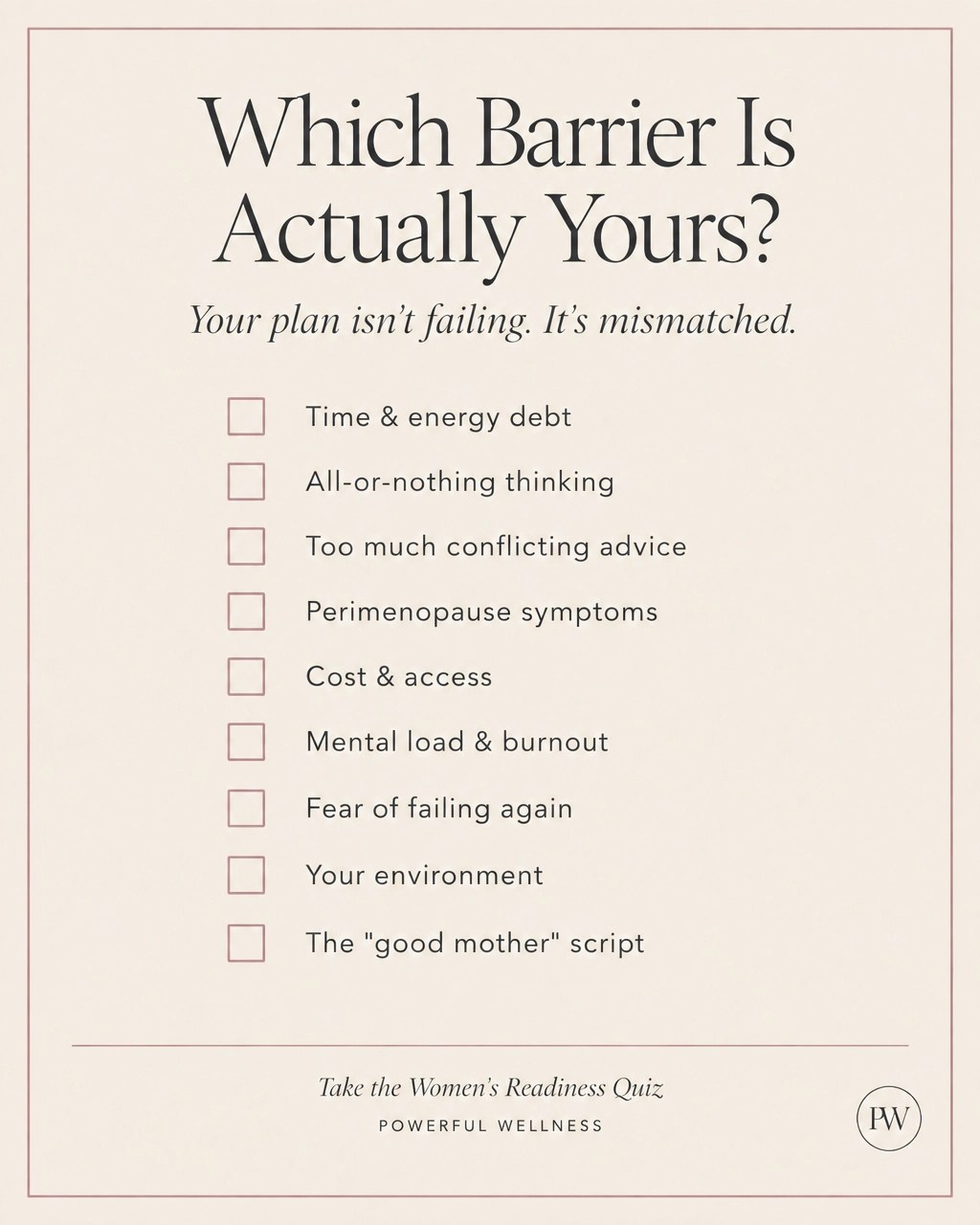
Take the Women's Readiness Quiz for Health and Wellness. It takes about two minutes and is designed to help you identify which barrier may be holding you back, and what to do first.
You do not need to prove that you are ready for a complete transformation. You only need enough information to choose an honest next step.
Use This Readiness Framework
Readiness is not a judgment. It is a place to begin.
1. Not ready: You are still in survival mode
You may be exhausted, overwhelmed, or focused on getting through the day.
Take one gentle step: acknowledge what is draining you and choose one form of support, such as asking for help, scheduling a healthcare visit, or going to bed earlier.
2. Getting curious: You are thinking about change
You may be reading, listening, and wondering what could work for you.
Take one gentle step: write down the health area that matters most right now. Do not create a complete plan yet.
3. Getting ready: You are testing small changes
You are willing to experiment, but you are still learning what fits.
Take one gentle step: test one habit for seven days and observe how it affects your energy, mood, sleep, or confidence.
4. Ready to act: You want structure
You are looking for a practical plan, accountability, and a way to stay consistent.
Take one gentle step: choose a specific time, place, and backup option for one health behavior.
5. Already moving: You need optimization
You have routines in place, but you want better results or more support.
Take one gentle step: review what is working, identify the point where you lose momentum, and adjust that part instead of starting over.
Every stage is legitimate. No stage is a failure.
Low-Cost, Low-Energy Moves That Still Count
Consistency does not require intensity. Try one of these realistic options:
- Take a 10-minute movement break while your coffee brews or your dinner cooks.
- Walk for five to ten minutes after one meal.
- Add protein to breakfast using an affordable option that works for you.
- Complete one strength session each week using bodyweight exercises or household items.
- Fix sleep before adding more goals. Protect a consistent bedtime and reduce one source of evening stimulation.
- Drink water whenever you see a specific cue, such as opening the refrigerator or sitting at your desk.
- Use stairs or park slightly farther away when it feels safe and appropriate.
- Batch-prep one protein, such as eggs, beans, chicken, tofu, or Greek yogurt.
- Practice a five-minute stress reset with slow breathing, quiet sitting, stretching, or stepping outside.
- Use free resources, including walking groups, community centers, libraries, or trustworthy movement videos.

Make Your Routine Easier to Keep
Build your routine around real life, not an imaginary week with unlimited energy.
Stack a habit onto something you already do. Stretch after brushing your teeth. Walk after lunch. Take medication with a consistent meal, as directed by your healthcare professional.
Start tiny. Make the first step so manageable that you can complete it on a busy day.
Track wins, not just weight. Notice better energy, more confidence, improved strength, a calmer evening, or one choice that supported your health.
Plan for the bad week. Decide in advance what your minimum routine will be when sleep is poor or responsibilities increase.
Tell one person. Choose someone supportive who can encourage you without criticizing or policing you.
Make the healthy choice the default. Put water within reach. Keep an easy protein available. Set out what you need for a short walk or stretch.

Your Sunday Reset
You do not need to fix everything this week.
You need to find the one barrier that is actually in your way, and take one honest step around it.
Maybe your first step is asking for help. Maybe it is treating a symptom. Maybe it is choosing a 10-minute routine instead of an impossible standard. Maybe it is simply admitting that you are tired and need support.
Take the Women's Readiness Quiz for Health and Wellness to discover which barrier may be holding you back and what to do first.
Then, when you are ready for more structure, join the Midlife Reset waitlist at midliferesets.com.
Medical Disclaimer
This article is for educational purposes only and does not provide individualized medical advice, diagnosis, or treatment. Health needs differ, especially during perimenopause and midlife. Talk with a qualified healthcare professional before changing medications, nutrition, exercise, or treatment plans. Seek prompt medical attention for urgent or concerning symptoms.